
Health-Focused Eye Exams
for Adults and Seniors
Our goal at Thompson Rivers Family Optometry is to make your eye care as simple, convenient, and comfortable as possible. Our team is experienced in assisting individuals with varying accessibility needs, including mobility issues, sensory sensitivities, and more.
We’re here to make your experience a positive one. Whether you just need a routine eye exam or you need comprehensive care for an eye condition, our compassionate team is here to assist. Our eye exams include a thorough eye health examination, screening for common conditions, and a vision test to update your glasses or contact lens prescription.
Booking an appointment is easy. You may fill out our online request form or call us directly at 250-376-1985. We look forward to welcoming you.
How Often Do I Need an
Eye Exam?
Everyone’s eyes and health are different, so your eye exam schedule should be too.
After your first exam, we’ll recommend a customized exam schedule and send you a reminder when it’s time to book your next appointment.
Usually, we recommend having a comprehensive eye exam every 1–2 years, depending on your eye health, risk factors, contact lens wear, and other considerations.
Prepare for Your Eye Exam
What to Bring:
Before your eye exam, please remove your contact lenses and bring them with you to your exam. By taking your contacts out prior to your appointment, we can more accurately check your eye pressure during the exam.
You should also bring your insurance information, any current prescription glasses or contact lenses you use, and a list of current medications.
What to Expect During Your Appointment
Check-In
Your eye exam begins by checking in with reception. If you’re new to the practice, you’ll have some health information forms to complete. You can pre-fill the forms and send them in before your appointment, or complete them at the clinic during check-in.
If you need to fill out the forms at the clinic, please arrive 10–15 minutes before your appointment time to allow yourself time to complete them.
For returning patients, you’ll be asked to confirm your personal information and whether you’ve seen a specialist for any eye concerns recently.
Pre-testing
Shortly after you check in, we’ll bring you in for pre-testing. This part of the appointment includes taking pictures of your eyes, checking eye pressure, and other quick diagnostic tests to examine the health of your eyes. Your pre-tester will ask questions about your eyes and vision during this stage.
Many eye conditions can begin without noticeable symptoms, so these tests help us check for any subtle signs of a problem before it affects your vision.
Your pre-testing phase will begin by measuring the prescription of your current glasses. Then, we’ll check your eyes with an auto-refractor and keratometer to quickly measure how well your eyes can see at a distance. You’ll rest your forehead and chin on the machine and look into the camera.
Then, we’ll take a picture of the inside of your eye using the Optomap. This device doesn’t touch your eye, but produces a bright flash when the picture is taken.
We’ll also test the eye pressure of everyone 15 years and older. This test uses a handheld device that tickles the surface of your eye to measure your intraocular pressure (IOP). Patients over the age of 40, those living with diabetes, and anyone with pre-existing eye conditions will also get an OCT test, which gives Dr. Allaway a detailed view of the layers of the eye.
Each machine used during pre-testing is charged to BC Medical to reduce the cost of your eye care. See more information about the technology below.
Exam and Meeting with the Optometrist
After pre-testing, you’ll meet with Dr. Allaway. He’ll review the results of your diagnostic tests with you and discuss your answers to the pre-tester’s questions.
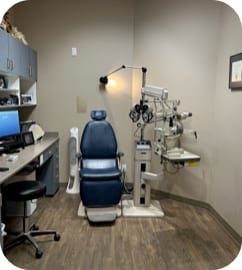
Then, Dr. Allaway will check your prescription. Using the auto-refractor results as a guide, he will use the large, glasses-like device to check which lenses provide the clearest vision. This part of the exam is a team effort, so be sure to ask questions or to see the options again if you’re unsure.
If you’ve seen a specialist, Dr. Allaway can also go through any information from the specialist during this portion of the exam to make sure you understand everything discussed.
Insurance and Billing
We try to bill your insurance in advance to provide you with a rough estimate of the cost of your eye exam. If you have any questions before or after the exam about your coverage, please ask our front desk team. They’re happy to assist you.
You can review our accepted insurance providers and payment methods online before your exam as well.
Technology Used in Your Exam
We work alongside technology during your eye exams to complete an in-depth examination of your eyes. We use various diagnostic tools to check your eye health during your eye exam. The purpose of these tools is to examine your eyes for any signs of eye disease or systemic health conditions that could impact your vision.
The tests included in your exam are chosen based on different factors, such as how long it’s been since your last eye exam, if you have a family history of eye disease or another condition that increases your risk, and whether you wear contact lenses regularly. The team is happy to explain the steps of each test and make sure you’re comfortable throughout.
We use the optomap, also known as the Optos ultra-widefield retinal imaging device, which allows us to capture an image of about 80% of your retina, which is the light-sensitive tissue that lines the inside of your eye.
The image captured by optomap shows us your retina, blood vessels, and optic nerve, which allows Dr. Allaway to check for many eye diseases as well as systemic conditions, such as diabetes, hypertension, multiple sclerosis (MS), and certain cancers that can impact the different structures in your eyes.
Optical coherence tomography (OCT) scans use light waves to map the different layers of your eye, creating a cross-sectional image of your retina. This allows us to monitor the thickness of each layer and detect changes to your eye health that may not be visible on a retinal image.
OCT scans are especially valuable tools to monitor individuals at risk of developing diabetic eye disease, glaucoma, age-related macular degeneration, and other conditions.
Our auto-refractor and keratometer (ARK) device measures your current refractive error. This refers to how well your eyes can see at a distance, and checks for conditions like myopia (nearsightedness), hyperopia (farsightedness), and astigmatism, which could impact your visual clarity.
The ARK measurement serves as a starting point for your prescription, which will be checked and finalized during your examination with Dr. Allaway.
We also have a small, handheld ARK device, which can be more accessible for individuals with disabilities, as well as for children.
The intraocular pressure (IOP) tonometry test is an important diagnostic screening test for glaucoma. This test does not have a puff of air; it uses a tiny probe that gently taps your eye. We compare the feeling to a tickle in your eye, and it’s very quick.
Tonometry is extremely important to glaucoma management. This eye disease can occur without noticeable symptoms, but it often causes an increase in IOP. By checking your eye pressure, we can catch signs of glaucoma before it affects your vision.
Trauma, such as an injury to the eye area, can also cause an increase in IOP. If you come in for an emergency assessment, we’ll also check your eye pressure.
Your visual field is the entire area you can see in every direction while your eyes are fixed on a central point. In other words, your visual field includes both your central and peripheral vision.
We check your visual field using a special machine that can measure the entire area that you can see. This measurement is important, as changes to your visual field over time can indicate an underlying condition.
We complete a visual field test on individuals who need to pass the vision requirement for their driver’s licence, as well as people with glaucoma or who have experienced a stroke.
Find the Help
You Deserve Today
Your eyes deserve comprehensive care and attention. We’re here to make your eye care experience simple, compassionate, and as stress-free as possible.
We want you to feel comfortable, cared for, and heard during your appointment. If you require specific accommodations or have any questions before your eye exam, please reach out to our team. We’re here to assist you.
Book your appointment with our team today.


Finding
Our Clinic
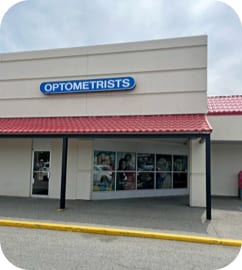
We’re located in the Northills Shopping Centre off Tranquille Road. Find our office between the CIBC and the Interior Health clinic on the north side of the mall. For your convenience, our entrance is directly accessible from the parking lot—no mall entry required.


Visit
Our Location
Our eye clinic is conveniently located at the Northills Shopping Centre, next to the CIBC.
Where to Park?
The mall offers spacious parking and accessible parking spaces.
Hours of Operation
*Closed between 12:00 PM and 1:00 PM every day for lunch
Our Google
Reviews
Our Featured
Eyewear Brands





Our Patient
Education Hub
Land
Acknowledgement
We’re grateful to live and work on Tk’emlúps te Secwépemc territory, within the unceded ancestral lands of the Secwepemcúĺecw. We acknowledge and respect the history, language, and culture of the Secwépemc people who have lived here since time immemorial. We make this acknowledgement as an act of reconciliation.

About Us
Services
Specialty Eye Exams
Patient Education Hub
Thompson Rivers Family Optometry
- 250-376-1985
- 250-376-1309
- office@trfo.ca